
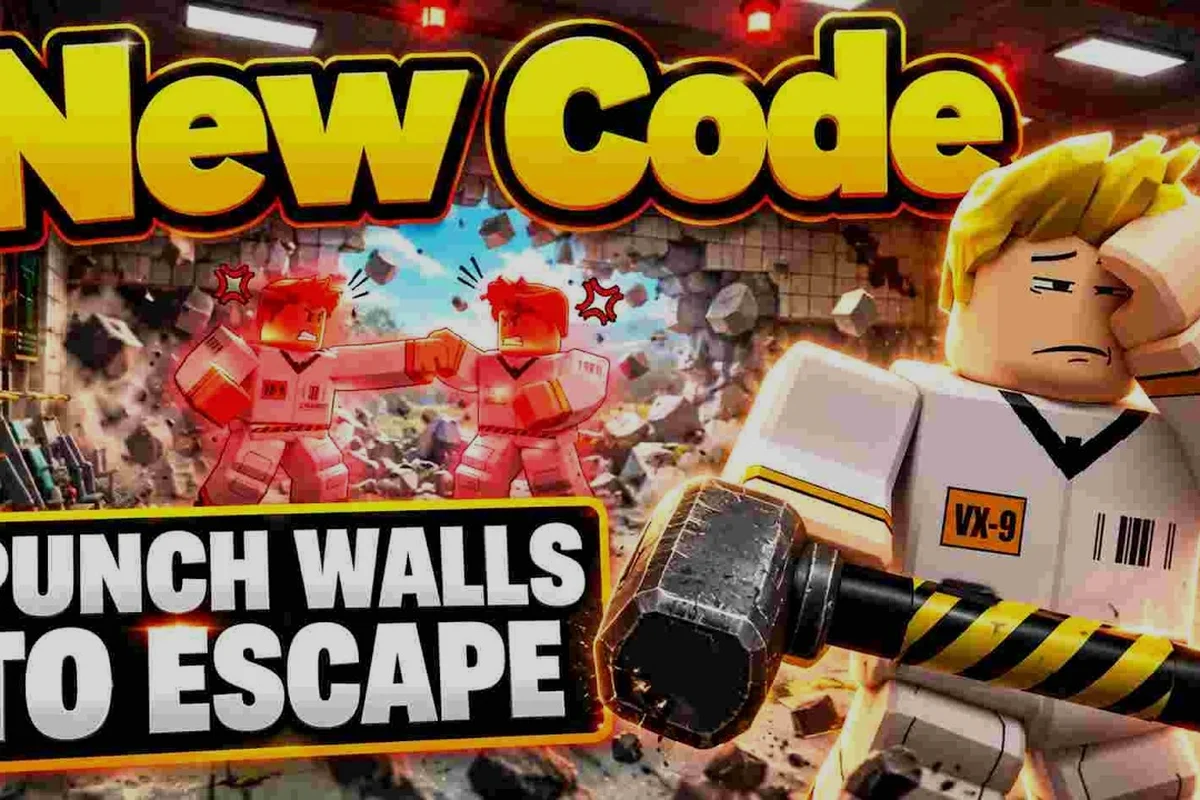
The Punch Walls to Escape GameRant article published on October 29, 2026, is the most-cited press mention the game has received so far, and it is also the most confusing. It describes a grinder, five floors, gems inside rare blocks, and a Sledgehammer-and-TNT toolset — details that do not appear on the official Roblox page. If you searched for that coverage and came away unsure what is real, this breakdown separates the verifiable from the unconfirmed.
For a full, up-to-date list of active Punch Walls to Escape codes and their rewards, see Game Rant's Punch Walls to Escape codes guide.
What the Punch Walls to Escape GameRant Article Actually Said
The roundup was framed as a code list, which is the first thing worth flagging. According to the write-up, players could expect redeemable codes tied to free crates and progression boosts. The article then padded that list with gameplay description: a grinder that processes materials, a prison tower with five floors, gems hidden in rare blocks and vaults, and a toolset built around a Sledgehammer and TNT.
None of those specifics match the official game description, which outlines a far simpler loop built on punching destructible walls and vacuuming up debris — no grinder, no five-floor tower, no gem-hunting, and no Sledgehammer or TNT toolset anywhere in the listed mechanics. That mismatch is the core of the story: a code roundup describing systems the official page never mentions, which is exactly why community channels on Reddit and Discord have spent days dissecting the coverage and questioning where the gameplay details originated.
| Claim in the October 29 Coverage | Status | What the Official Page Shows |
|---|---|---|
| Redeemable code list | Unverified | No code system mentioned |
| Grinder for processing materials | Unconfirmed | Not described |
| Five-floor prison structure | Unconfirmed | Floor count not stated |
| Gems in rare blocks and vaults | Unconfirmed | Not described |
| Sledgehammer and TNT tools | Unconfirmed | Punching and vacuuming only |
The pattern matters more than any single line. A code roundup normally requires a code system to exist, and the official page never mentions one. Community reports back that up: several creators have posted "free crate code" videos, but none of them show a working redemption screen, and no developer post confirms a code field anywhere in the experience.
Why the Details Clash With the Official Page
Roblox classifies the game as a Simulation / Incremental Simulator, and the official description supports that label with a tight loop: punch walls, vacuum debris, fill buckets, repeat. There is no crafting bench, no ore processing, and no explosive inventory in that description.
The most likely explanation is that the roundup was assembled from secondary sources rather than play sessions — a common outcome when a game trends fast. The page's own last-updated stamp was October 28, 2026, roughly two weeks into the game's life, which is a very short window to verify mechanics. When a title rises this quickly, writers sometimes pull details from adjacent escape games or from early speculation threads.
That does not make the coverage malicious. It makes it unverified, and treating it that way is the safest reading until the developer says otherwise. Note the asymmetry in what is actually checkable: the official page's Simulation / Incremental Simulator tag and its punch–vacuum–bucket loop can be confirmed in a single session, while the roundup's claimed crafting bench and ore processing cannot be traced to any official listing, patch note, or developer post. Until a Punch Walls to Escape Discord community announcement or fan wiki entry corroborates those mechanics, the October 28, 2026 stamp should be read as a snapshot of secondhand claims rather than a verified feature list.
How Punch Walls to Escape Press Mentions Spread So Fast
The speed of the coverage is easier to explain than its accuracy. The Steam indie hit Escape the Walls went viral first, and Roblox follow-ups appeared within days of that spike. The copycat wave is the real engine behind the visibility, and it pushed the game into recommendation feeds before anyone had time to document it properly.
Press mentions followed the trend curve rather than a marketing campaign, which means coverage volume tracked the Escape the Walls spike almost hour for hour instead of any coordinated outreach. That has two consequences worth understanding. First, the Punch Walls to Escape GameRant article and similar write-ups landed while the Roblox map list was still shifting, so features described in one outlet could already be outdated by the next. Second, because the copycat wave drove visibility, the Punch Walls to Escape press mentions cluster around discovery and first-impressions framing rather than deep mechanic breakdowns — outlets had hours, not days, to publish.
-
Coverage arrived before a stable, documented feature set existed.
-
Outlets competed on speed, so unverified details propagated quickly.
-
Community channels became the de facto fact-check layer.
The Roblox trending game breakdown traces how that copycat wave formed in October 2026, and it explains why so many escape-style experiences launched in the same window. Understanding that timeline makes the coverage discrepancies far less mysterious — the game was written about during its most volatile week.
Where Punch Walls to Escape Reddit Discussions Land on the Claims
Reddit threads have done most of the skeptical work. The recurring pattern in Punch Walls to Escape Reddit discussions is a player asking whether the codes work, followed by replies confirming that nobody has found a redemption box, a code field, or a developer post announcing one. Threads that start with excitement usually end with a shrug.
A second cluster of discussion focuses on the described tools. Players who have actually played report the same thing the official page does: you punch, you vacuum, you carry buckets. No one has posted a screenshot of a Sledgehammer or a TNT charge inside the experience.
| Community Venue | Dominant Topic | Reliability Signal |
|---|---|---|
| Reddit threads | "Do the codes work?" | Consistent skepticism, no proof posts |
| YouTube comments | Gameplay clips vs. code videos | Clips show punching loop only |
| Discord servers | Trading tips and floor routing | Mixed, some secondhand claims |
| Fan wiki pages | Mechanic documentation | Thin, partly copied from coverage |
The honest summary is that Reddit has produced no evidence supporting the code claims and a fair amount of evidence against them. That is not proof of absence, but it is the strongest signal available right now. The asymmetry matters: a single working code screenshot or a redemption box capture would settle the question in minutes, and in a community that already posts Sledgehammer sightings, TNT charge clips, and floor-routing maps, the absence of even one verified post is telling. Until a Punch Walls to Escape fan server or fan wiki page logs a confirmed code, treat every "working codes" list as unverified.
Reading Skepticism Correctly
A common mistake is treating "no one has confirmed it" as "it is definitely fake." Those are different statements. The accurate position is that the claims remain unverified as of October 31, 2026, and that the burden of proof sits with whoever published them first.
Players who want to test for themselves can do so cheaply. Load the experience, scan the interface for any code entry field, and check the developer's group page for announcements. If nothing turns up in a few minutes, the practical answer for gameplay purposes is that codes are not part of the loop.
Inside the Punch Walls to Escape Discord Community and Fan Servers
The Punch Walls to Escape discord community has become the fastest place to get a straight answer, largely because responses come from people actively playing rather than from aggregator sites. Servers typically split into channels for general chat, clip sharing, and trading or progression questions, and the code question surfaces in general chat almost daily.
Fan servers vary wildly in quality. Some are well moderated and quick to correct misinformation; others repeat the same unverified claims that started the confusion, often because a "free code" post gets copy-pasted across multiple Punch Walls to Escape fan server invites without anyone checking the GameRant article it supposedly came from. A few practical filters help you tell them apart, starting with how a server handles the code question the moment it resurfaces in general chat.
-
Pinned messages that cite the official page rather than a roundup article.
-
Moderators who remove "free code" posts lacking proof.
-
Recent activity — a server with clips from the last 48 hours is more useful than one with a stale feed.
If you are choosing where to spend time, the community guide to real and fake hubs walks through how to spot servers that actually document the game versus ones that recycle press claims. That distinction saves hours when a title is trending and information is noisy.
What Fan Wikis Get Right and Wrong
The Punch Walls to Escape fan wiki situation mirrors the servers. The better pages stick to what can be observed: the punching loop, the vacuum mechanic, bucket capacity, and how floors gate progress. The weaker pages lift paragraphs from coverage articles and present them as documented fact.
A quick test works well here. If a wiki page describes a mechanic, ask whether it links a clip or a developer statement. Pages that cite nothing are usually paraphrasing the same unverified roundup, and the error compounds each time it is copied.
Verifying Punch Walls to Escape Community Server Claims Yourself
The most useful skill in this situation is a repeatable verification routine. It takes about five minutes and it beats trusting any single article, including this one. The reason is structural: a GameRant-style press mention, a Reddit thread, and a Discord fan server each fail in a different way — the article may recycle a stale claim, the Reddit post may confuse a fan server code with an official one, and the Discord community may pass around a screenshot with no source. Running the same five checks against every new Punch Walls to Escape claim lets you separate what the developer group actually announced from what the fan wiki merely repeats, so a single convincing post never becomes your whole basis for believing a code exists.
| Step | Action | What Confirms the Claim |
|---|---|---|
| 1 | Open the official game page | Feature list and genre label |
| 2 | Scan the in-game UI for a code field | A visible redemption input |
| 3 | Check the developer group announcements | Any official code post |
| 4 | Watch a recent gameplay clip | Tools and mechanics actually shown |
| 5 | Cross-check two community servers | Independent agreement |
Steps two and three are the decisive ones for the code question because they test the two things a fake code claim cannot fake: a visible redemption input in the game's UI and an announcement from the developer group itself. Everything else is supporting context. A GameRant article citing a "Punch Walls to Escape code" typically fails at step two, since a wall-punching escape game built around fists, a vacuum, and a bucket has no shop or currency screen where a code field would sit. If a claim survives all five steps, it is worth repeating; if it fails at step two, it is not.
The gameplay breakdown of the fists, vacuum, and bucket loop documents what the experience actually contains, which gives you a baseline to compare any new claim against. When a fresh article describes a mechanic that is not in that baseline, the burden shifts back to the article.
Spotting Recycled Coverage
Recycled coverage has fingerprints. Look for the same unusual nouns appearing across unrelated sites — a grinder, five floors, rare-block gems, a Sledgehammer. When three outlets use identical phrasing and none of them show a screenshot, they are almost certainly working from one source.
Another tell is a code list with no expiry dates and no redemption instructions. Real code coverage almost always includes where to enter the code and when it stops working. A list missing both is a strong hint that no one tested it.
Why This Coverage Still Matters for Players
It is tempting to dismiss a flawed roundup as harmless noise, but the downstream effects are real. New players arrive expecting a grinder and a code system, find neither, and conclude the game is broken or that they are missing a menu. That confusion shows up in Reddit threads and server chat constantly.
There is also a subtler cost. When coverage describes features that do not exist, it distorts what the game is. The actual appeal is a tight incremental loop — punch, vacuum, upgrade, push deeper — and that loop is genuinely satisfying without a crafting bench attached to it. The server and performance update notes show where developer attention has actually gone, and it has gone toward stability and latency rather than new tool systems.
That skepticism is a transferable skill, not a one-off correction. The same pattern — a GameRant-style roundup describing a code system or crafting bench that never shipped — recurs across trending Roblox titles, so the practical habit is to verify claims against primary sources before trusting them: the in-game UI, the official server and performance update notes, or a community-maintained fan wiki that tracks actual patch history. Cross-checking a single claim like "codes exist" against the Discord community or a fan server usually settles it in minutes, and that verification loop is what separates players who adapt quickly from those who quit over a feature that was never real.
Other Coverage Worth Reading After This One
The clearest resolution would be a developer statement, either confirming a code system exists or clarifying that coverage was mistaken. Until then, watch three signals: whether an official code post appears, whether a redemption field shows up in the interface, and whether the described tools ever appear in a clip from a credible creator.
If all three stay quiet through the next update cycle, the coverage can be treated as a closed case of premature reporting rather than a hidden feature set. The community update log tracks those changes as they land, which is a more reliable signal than any single article published during launch week.
Frequently Asked Questions
Are the codes from the Punch Walls to Escape GameRant article real?
No working code has been verified. The official page never mentions a code system, and community reports found no redemption field in the interface. Several creators posted code videos, but none demonstrated a successful redeem. Treat the list as unconfirmed until the developer announces something official.
Where do most Punch Walls to Escape Reddit discussions stand on the coverage?
Reddit threads are consistently skeptical. Players asking about codes are usually told that nobody has found a redemption box or a developer announcement. The threads also note that described tools like the Sledgehammer and TNT have never appeared in a gameplay screenshot or clip.
Is the Punch Walls to Escape discord community a reliable source?
It is the fastest source, not an automatically reliable one. Well-moderated servers correct misinformation quickly and pin links to the official page, while weaker servers repeat unverified claims. Check whether clips and answers are recent and whether moderators remove unproven code posts.
What does the game actually involve if the coverage is wrong?
The official description and community clips agree on a simple incremental loop: punch walls to break through, vacuum the debris, fill buckets, and push deeper. Roblox labels it a Simulation and Incremental Simulator. There is no crafting bench or explosive inventory in that documented loop.
How can I check a Punch Walls to Escape fan wiki claim quickly?
Open the official game page and compare the claim against the listed features, then scan the in-game interface for the described mechanic. If a wiki page cites no clip or developer statement, it is likely paraphrasing the same unverified roundup that started the confusion.
The October 29 coverage is best read as a snapshot of how fast-moving trends outpace verification, not as a feature list. The verifiable game is a punching-and-vacuuming incremental loop; the grinder, the five floors, the rare-block gems, and the code list remain claims without a source. Check the official page and recent clips before you plan around any of it.