
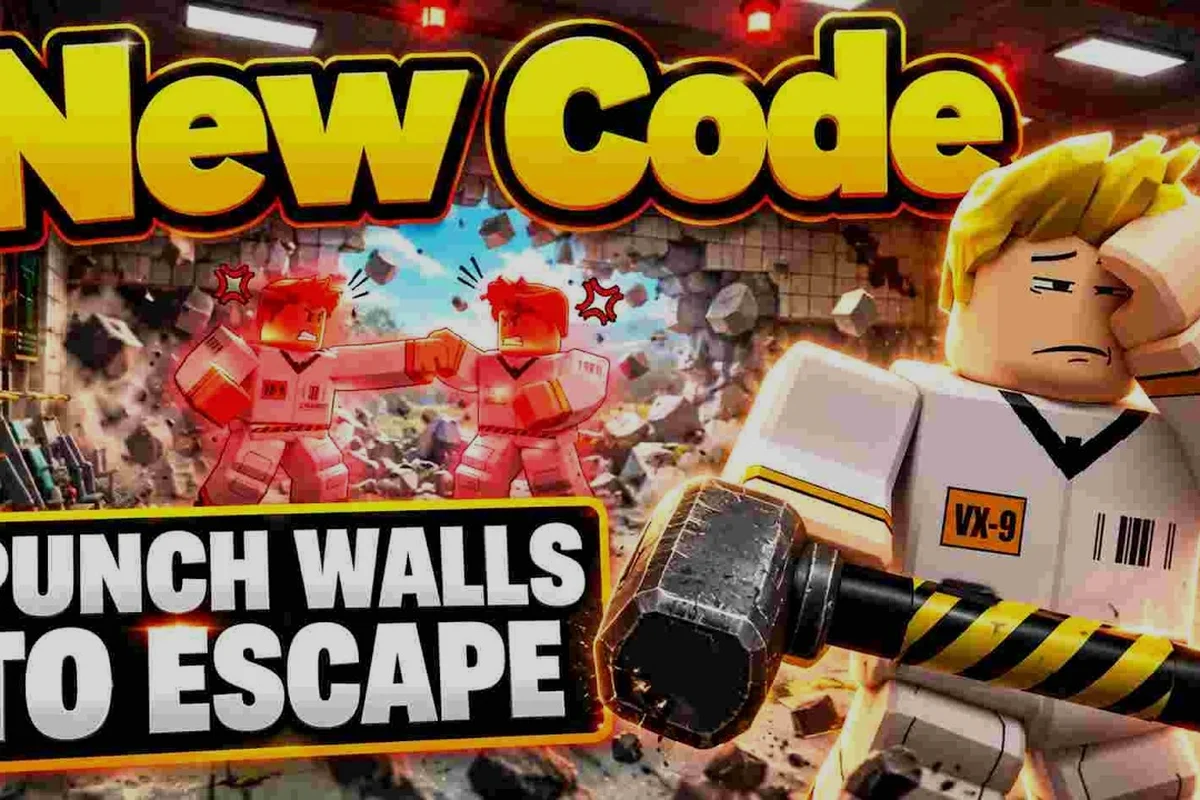
Punch Walls to Escape clips are the fastest way to understand a game that blew up almost overnight, and they split cleanly into two camps: genuine gameplay runs and code videos that promise free crates nobody can verify. Knowing which is which saves you from wasting time on fake rewards.
The game racked up 1,183,105 visits by October 31, 2026, and most of that attention arrived through short-form video rather than a long marketing campaign. That means the clip feed is where the real information lives, and also where the misinformation lives.
What These Punch-Wall Clips Really Demonstrate
The core loop is simple enough to fit in a fifteen-second short: you punch wall blocks loose one at a time, vacuum up the rubble, dump each load into the Bottomless Bucket, and get paid cash on the spot. Every authentic clip shows some version of that sequence, whether it runs thirty seconds or ten minutes.
That consistency is useful. If a video never shows punching, vacuuming, or the bucket, it probably isn't gameplay at all. Community channels regularly publish how-to-play and gameplay clips, and the three verified uploads circulating in late October 2026 all follow the same pattern.
-
Becon published a short titled "WE HAD TO ESCAPE PRISON WITH BARE HANDS?!" on October 29, 2026, focused on the punching and vacuuming loop.
-
ToyTaanic uploaded "PUNCH THE WALL to Escape PRISON... (Roblox)" on October 31, 2026, showing the same block-by-block progression.
-
Toeox minus posted "Escaping Prison by Breaking Walls in Roblox" the same day, again centered on the core mechanic.
Notice that all three titles frame the game as a prison escape — "ESCAPE PRISON," "Escape PRISON," "Escaping Prison." That's community framing, not official description: none of the three uploads positions the prison angle as a named game mode, and the core loop they actually show (punch, vacuum, bucket, cash) is identical across all of them. Treat the titles as entertainment packaging rather than documentation — the "Punch Walls to Escape" label in a video title tells you what thumbnail hook the creator chose, not what the game calls itself.
Why the Short Format Dominates
A game built on repetitive physical actions suits short video perfectly. One punch, one vacuum, one cash payout — the whole appeal fits in a loop that reads instantly on a phone screen. Longer uploads exist, but the Punch Walls to Escape buzz is concentrated in shorts because the mechanic is self-explanatory.
The tradeoff is depth. A thirty-second clip shows you what the game looks like but not how progression works, how fast cash accumulates, or whether the loop holds up after an hour. For that, you need the longer runs covered in our gameplay videos breakdown.
Real Gameplay Runs vs Code Claim Videos
This is the split that matters most, and it's easy to spot once you know the tell. Real runs show the loop. Code videos show a creator talking to camera with a list on screen and almost no gameplay footage.
| Signal | Real gameplay clip | Code claim video |
|---|---|---|
| On-screen action | Punching, vacuuming, bucket dumping | Talking head or static list graphic |
| Length | 15 seconds to 10 minutes | Often 3-8 minutes of padding |
| Claim type | "Here's how the loop works" | "Free crates with these codes" |
| Verifiable source | Visible in the footage itself | None — no developer list cited |
| Comment section tone | Questions about mechanics | Requests for working codes |
The code side is where the misinformation concentrates. Several channels post videos claiming free crates, but no code list is verifiable through the developer, and the official description never mentions a code system at all. That's not a small detail — it means every code claim currently circulating sits in unverified territory.
How to Test a Code Video in Ten Seconds
Before you spend eight minutes watching, run this check: a genuine Punch Walls to Escape codes video should pass a quick three-point screen. Watch for the moment the creator actually redeems the code live in-game, since a montage that only flashes text on screen proves nothing about whether the Punch Walls to Escape redemption system even exists. Then confirm the creator cites a specific official source, such as the developer's Discord or verified social account, rather than a "trust me" caption. Finally, check the upload date against the game's rapid update cadence, because a list from two weeks ago may already be stale after a patch.
-
Does the video show the code being redeemed in-game, with the reward appearing on screen?
-
Does the creator name a specific official source for the list?
-
Does the upload date fall within the last few days, given how fast this game changes?
If all three answers are no, the video is entertainment, not information. Community reports on the game's official channels have never confirmed a redemption system, so treat any list as unproven until you see it work in footage. The tell is usually the reward itself: a working Punch Walls to Escape code drops a visible payout — extra Clips, a cosmetic unlock, or a stat boost — the instant it's entered, so a clip that cuts away right after the code is typed, or shows only a text overlay with no in-game confirmation, is the strongest signal the "code" is fabricated for views.
Reading the Punch Walls to Escape Trending Wave
The game's rise is tied to a copycat moment rather than a slow build. The Steam indie Escape the Walls went viral, and Roblox follow-ups appeared within days, which is why this experience climbed so fast in October 2026. That context explains a lot about the clip feed.
When a trend moves this quickly, the video library grows faster than any verification process can keep up. Creators chase the same search terms, titles get more dramatic, and claims get bolder. The roblox trending game analysis tracks how that copycat wave formed and why so many near-identical experiences appeared at once.
| Timeframe | What the clip feed looked like |
|---|---|
| Early viral phase | Shorts showing the punch-and-vacuum loop, mostly raw gameplay |
| Peak attention | Title inflation — "BARE HANDS," "PRISON," all-caps hooks |
| Saturation | Code videos, tier claims, and unverified feature lists |
| Current state | Mixed feed; gameplay still dominant but claims rising |
The practical takeaway: older clips tend to be more honest because there was less competition for attention. The early viral phase uploads mostly captured the raw punch-and-vacuum loop with no commentary, which makes them the cleanest reference for how the mechanic actually behaves. Newer uploads are where the exaggeration lives — during peak attention, all-caps titles like "BARE HANDS" and "PRISON" multiplied, and by saturation the feed filled with code videos and unverified feature lists that rarely match what the current build does. When judging a Punch Walls to Escape montage, check its upload date against that timeline first.
The Wake it UP Connection
Searches for Punch Walls to Escape Wake it UP keep surfacing alongside clip queries, and the two are related through the same trend wave. The Wake it UP studio connection is covered in detail in our Wake it UP games explainer, which traces the verified developer trail behind the experience.
What matters for clip-watching is simpler: a lot of videos attach studio names and feature claims that don't trace back to any official page. If a clip's description promises offline earnings, AFK rewards, or rebirth systems, check whether the official page mentions any of it. As of late October 2026, it doesn't.
Building a Reliable Clip Watchlist
A good watchlist mixes formats on purpose, because each one exposes a different layer of the escape loop. Shorts teach you the feel of the game — how fast the punch charge builds and where the wall cracks first — while longer runs teach the pacing, showing how cash accumulates across multiple wall breaks before a redemption is even attempted. Montages teach you what skilled play looks like: efficient routing between punch nodes, bucket management under pressure, and the timing windows that separate a clean escape from a wasted run. Relying on one format gives you a distorted picture — all shorts and you miss the economy, all montages and you miss the grind that makes those highlight escapes possible.
Here's a workable split for a first session: cap the total at roughly twenty minutes, because watchlist value comes from coverage rather than volume. Two or three shorts let you confirm the punch-charge loop matches expectations before committing more time, while a single longer run of five-plus minutes reveals how cash accumulates across consecutive wall breaks — the pacing layer shorts simply cannot show. Pair that with one montage for routing and bucket management, and hold all code videos until a redemption is shown working on screen, since unverified claims are the fastest way to waste a session.
-
Two or three shorts to confirm the loop matches what you expect.
-
One longer run of five minutes or more to see how cash accumulates over time.
-
One montage to observe efficient routing and bucket management.
-
Zero code videos until a redemption is shown working on screen.
The best clips ranking sorts the fastest escapes by actual footage, which is a better use of twenty minutes than scrolling a feed of unverified claims. The distinction matters because a ranked entry typically timestamps the full punch-charge-to-wall-break sequence, so you can verify the cash total shown at redemption against the number of wall breaks that preceded it — a claim a raw trending feed rarely survives. Use the ranking as a filter, not a substitute for the format mix above: pull two or three ranked shorts to confirm the punch-charge loop, then cross-check the top montage against its longer run to see whether the routing holds up under bucket pressure.
What Montages Teach That Shorts Don't
A Punch Walls to Escape montage compresses dozens of runs into a few minutes, which makes patterns visible. You start noticing that experienced players vacuum in tight clusters rather than chasing individual blocks, and that bucket trips get batched instead of made one at a time.
Those habits don't appear in a single short because a single short only shows one attempt. Montages show repetition, and repetition is where efficiency lives. If you're still learning the basics, the beginner guide covers the loop fundamentals before you start copying advanced routing from a highlight reel.
Spotting a Genuine Punch Walls to Escape Fansite
Fan hubs multiply fast around Punch Walls to Escape trending clips, and quality varies wildly — some aggregate every Punch Walls to Escape montage and Wake it UP edit without checking a single source. A useful fansite has three traits: it links to the official game page, it separates confirmed mechanics (like the actual punch-to-wall escape input) from speculation, and it dates its claims so you can tell a fresh Punch Walls to Escape buzz post from a recycled one.
| Fansite trait | Green flag | Red flag |
|---|---|---|
| Sourcing | Links to official page and dated posts | No sources, no dates |
| Code coverage | Says "no verified codes" | Lists codes with no proof |
| Mechanic claims | Matches visible gameplay | Promises AFK or offline income |
| Update handling | Notes that features change fast | Presents old data as current |
The dating habit matters more than anything else here. This game is very new and changes quickly, so a claim from three weeks ago may already be stale. Any hub that doesn't timestamp its content is asking you to trust information with no expiry date.
Cross-Checking Community Hubs
The community guide to real and fake hubs walks through how to separate legitimate fan spaces from engagement farms, and its checklist maps directly onto the Punch Walls to Escape clips ecosystem. The short version: real hubs answer questions — linking the actual Wake it UP clip source, timestamping the montage's punch-wall escape segment, or explaining why a trending clip cuts off mid-frame — while fake hubs collect clicks with recycled thumbnails and auto-generated captions. Applying that lens to Punch Walls to Escape fansite results matters, because a hub that can trace a clip back to its original upload is far more useful for verifying buzz than one that simply reposts the same montage under five different titles.
One more signal worth watching is how a hub handles the code question. A site that admits no verified code list exists is being honest about the limits of what's known. A site that publishes a fresh list every few days is generating content, not reporting facts.
For a closer look at how these punch-through wall clips play out in practice, the Punch Walls to Escape gameplay clips on YouTube show the technique being executed in real time.
Using Clips to Improve Your Own Runs
Watching is only useful if it changes what you do. The most common improvement visible across community footage is bucket discipline — experienced players fill the Bottomless Bucket close to capacity before making a trip, while newer players dump small loads repeatedly.
The second visible habit is punch sequencing. Rather than attacking whichever block is closest, strong runs clear in a pattern that keeps rubble concentrated in one area, which makes vacuuming faster. You can see this clearly in any run longer than two minutes.
If you're still dialing in the basics, the controls guide covers punching, vacuuming, and bucket handling on both keyboard and mobile touch, which is worth reviewing before you try to copy routing from a highlight clip.
A Simple Practice Routine
Try this sequence across three sessions, and treat each one as a controlled comparison rather than passive viewing: the goal is to convert what you see in a Punch Walls to Escape clip into a repeatable input pattern. Session one isolates punching rhythm — watch two shorts, then spend ten minutes in-game hitting walls on a steady beat so the timing of each punch becomes muscle memory instead of guesswork. Session two shifts to efficiency, watching a single montage before practicing batching bucket trips so you learn to chain wall breaks without backtracking across the map. Session three tests recall: watch a full Punch Walls to Escape run, then try to match its clear order for one wall section, comparing your route against the clip's. Spacing the three sessions lets each skill settle before you stack the next, which is why small, focused comparisons beat passive watching every time.
-
Session one: watch two shorts, then play for ten minutes focusing only on punching rhythm.
-
Session two: watch one montage, then practice batching bucket trips.
-
Session three: watch a full run, then attempt to match its clear order for one wall section.
Small, focused comparisons beat passive watching every time, because a Punch Walls to Escape clip only teaches you something once you've tested its timing against your own inputs. Watching a montage without playing afterward leaves you with a vague impression of speed; running the same wall section right after viewing forces you to notice where your punch rhythm drifts from the clip's, where your bucket batching wastes a trip, and where the clear order breaks down. The clip feed works best as a reference library you consult before a deliberate practice block, not as a substitute for playing — treat each Punch Walls to Escape trending short as a hypothesis to verify in-game rather than a highlight to admire.
Frequently Asked Questions
Are the free crate codes in Punch Walls to Escape clips real?
No verified code list exists. Several channels post videos claiming free crates, but no code list is verifiable through the developer, and the official description never mentions a code system. Until you see a redemption work on screen in a dated clip, treat every code claim as unproven.
Which Punch Walls to Escape clips are worth watching first?
Start with the three verified community uploads from Becon, ToyTaanic, and Toeox minus, all published in late October 2026. They show the actual punch, vacuum, and bucket loop rather than commentary, which makes them the most reliable introduction to how the game plays.
Why did Punch Walls to Escape become trending so quickly?
The Steam indie Escape the Walls went viral, and Roblox follow-ups appeared within days. That copycat wave pushed the experience to 1,183,105 visits by October 31, 2026. The speed of the rise explains both the volume of clips and the amount of unverified claims floating around.
Do montage videos actually help me play better?
Yes, if you watch for patterns rather than highlights. Montages reveal bucket discipline and punch sequencing that single shorts can't show, because they compress many attempts into a few minutes. Watch one, then practice the habit it demonstrates for ten minutes before watching another.
Is there an official Punch Walls to Escape fansite?
Not one confirmed by the developer. Fan hubs exist and vary in quality, so check whether a site links to the official game page, dates its claims, and admits when no verified code list exists. Hubs that publish fresh codes every few days are generating content rather than reporting facts.
The clip feed around this game is genuinely useful once you filter it, because the mechanic is visual and short video captures it well. Watch the runs, skip the code promises, and check dates on everything — that habit alone puts you ahead of most of the audience scrolling the same feed.